
Installation & Adjustment
General background to help you plan an installation and get a door behaving properly. This is not a substitute for the installation drawing of a specific model — ask us for the model-specific instructions before drilling anything.
Guides
- How to choose a door closer power sizePower size matches a closer to a door's width and weight. How to read the number, and why the largest is not the safest choice.
- How to measure door width and door weightMeasure the leaf, not the opening. How to take the width, how to estimate weight from size and material, and what to send us if you cannot weigh it.
- Installation and closing-speed adjustmentWhat the two adjustment valves do, how to set closing speed and latch speed, and the order to do it in. Plus what to check before leaving the door.
- Surface-mounted vs concealed door closersThe practical difference is when you have to decide. Surface-mounted fits an existing door; concealed needs the leaf machined for it.
- What EN 1154 and the available fire-door documents coverEN 1154 is the European standard for controlled door closing devices. What it covers, and what our own certificates and test reports actually say.
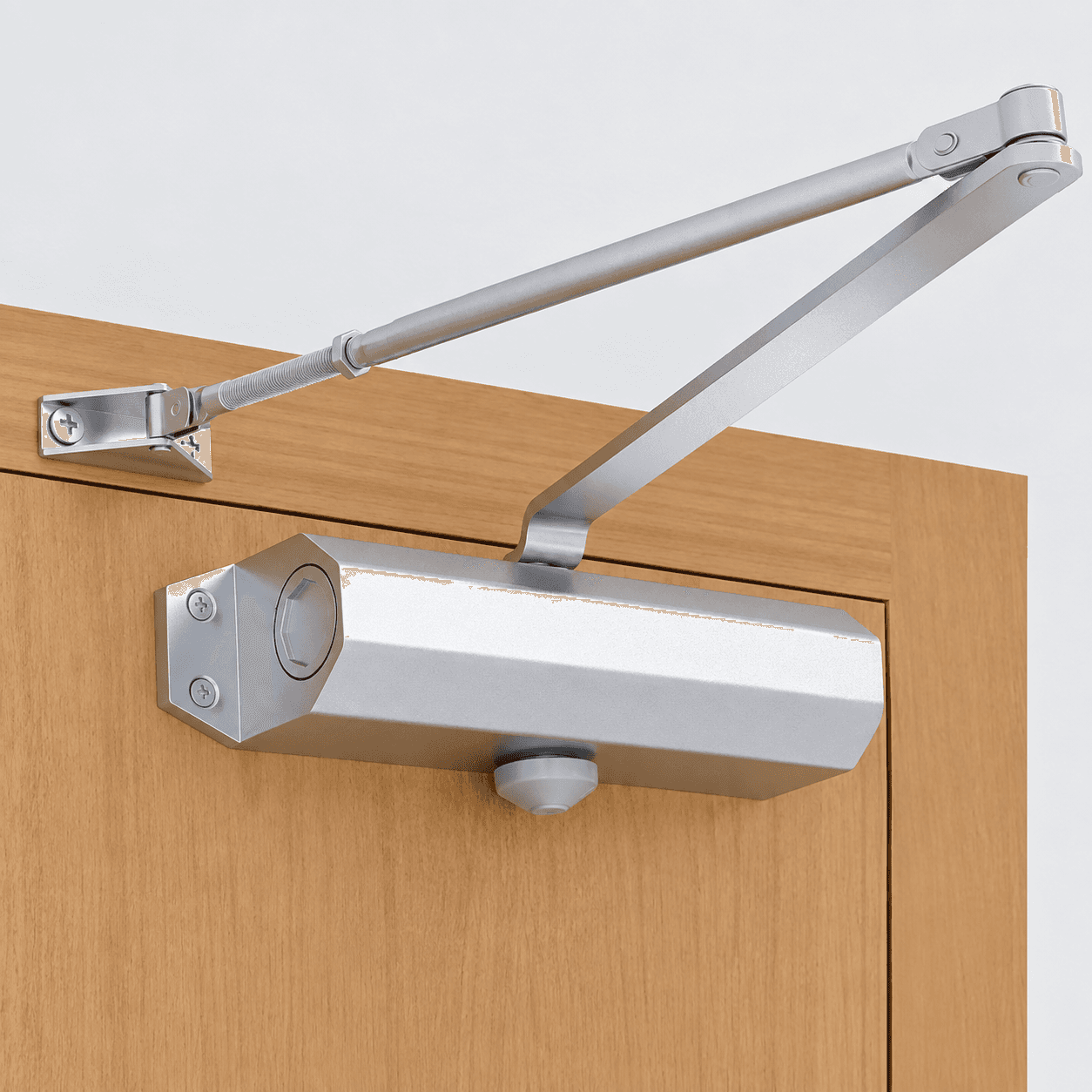
How a door closer works
Opening the door compresses a spring inside the closer body. When you let go, the spring pushes the door shut — but instead of releasing all at once, the motion is held back by oil forced through small adjustable valves. That is the whole idea: the spring provides the force, the hydraulics decide how fast it is allowed to happen.
Almost everything that goes wrong with a closer is one of those two halves being wrong for the door: too little spring for the leaf, or valves set for a different situation than the one the door is actually in.
Mounting arrangements
Regular arm (pull side)
Closer body on the door leaf, arm bracket on the frame above, installed on the side the door opens towards you. The most common arrangement and usually the most efficient — the arm works at a good angle, so you get the most closing force for the size.
Parallel arm (push side)
Body on the door leaf on the side the door swings away from you, with the arm folding back parallel to the door. Chosen when the arm must not project into a corridor, or where the pull side has no room. Typically gives less mechanical advantage than a regular arm, so it can be worth going a size up.
Top jamb
Body mounted on the frame face above the door rather than on the leaf itself. Used where the door leaf cannot be drilled — glazed doors, some fire doors, or leaves too thin to hold the fixings.
Which arrangements a given model supports depends on the model and the brackets supplied. Tell us which side of the door you need to mount on and we will confirm what is required.
Adjusting the speed
Hydraulic closers normally have two separate valves, adjusted with a small screwdriver:
- Sweep speed — controls the main part of the swing, from fully open down to roughly 15° from closed.
- Latch speed — controls the last few degrees, where the door has to push the latch into the keep. This one is why a door either clicks shut politely or bangs.
Some closers also have backcheck, which resists the door being flung open, and delayed action, which holds the door open a few seconds before closing. Whether a particular model includes these varies — ask us about the specific model rather than assuming.
Adjust in small increments — no more than a quarter turn at a time — and test the door after each one. Never force a valve past its stop or wind one all the way out: both can destroy the seal and cause the oil leak that ends the closer's life.
Common faults and what causes them
The door slams
Usually the latch-speed valve is open too far, or the closer is oversized for the leaf. Close the latch valve in small steps first. If it still slams at the very end regardless of the valve, the size is likely wrong for the door.
The door does not close fully / does not latch
Either the closer is undersized for the door width and weight, or something is resisting it: a stiff latch, a dragging seal, a carpet, a hinge out of alignment, or air pressure pushing back. Check the door swings freely with the closer arm disconnected before blaming the closer.
The door closes far too slowly
The sweep-speed valve is closed too far, or the closer is cold. Hydraulic oil thickens in low temperatures, so a closer set in summer may be noticeably slower in winter — it often needs a seasonal touch-up rather than a repair.
Oil is leaking from the body
An internal seal has failed and the unit cannot be repaired in place — it needs replacing. Over-tightening an adjustment valve past its stop is a common cause, so adjust gently and never force a valve.
It worked when installed and got worse over months
Most often the door itself moved — hinges settling, a frame shifting with the seasons, a new draught excluder adding friction. Re-check the door on its own before adjusting the closer.
Before you install
- Confirm the door leaf width and weight against the model's specification — see the selection guide.
- Check the door swings freely and latches by hand before fitting the closer.
- Confirm the leaf material and thickness will hold the fixings.
- For fire-rated openings, confirm the certificate applies to your exact model and market before installing.